


Reader-Submitted Story
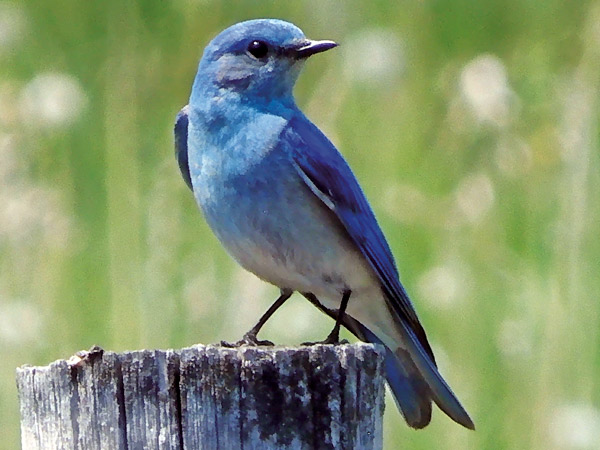
Gems of the Foothills
by Norm Brennand of Okotoks, Alberta
By a country mile, my favourite feathered friends are Alberta’s mountain bluebirds. No one specific reason, they just are. They are seldom seen in urban settings, their home is in foothills country, and of course, the mountains. For such a beautiful and stunning bird, I think it’s ironic to say most Canadians have never seen a mountain bluebird. Fortunately, we Albertans can watch them with little effort, as they are so very easy to find.
On rare occasion the eastern bluebird and western bluebird will be seen in Alberta, but I’m thinking that when someone says they’ve seen a bluebird in our province, 99.9% of the time it is our mountain bluebird. I’ve only seen one eastern bluebird in my life and that was on the side of the road; unfortunately, struck by a car.
Due to declining populations of bluebirds, well over half a century ago, there was much concern as to the future of mountain bluebirds in Alberta. The steady drop in bluebirds was believed to be due to the introduction of starlings and other competitive species, such as swallows, who made natural nesting locations difficult to find for our bluebirds.
Only once have I come across bluebirds while hiking in the Kananaskis mountains, so it is correct in saying they are difficult to find under normal circumstances. But thanks to very thoughtful and caring ranchers, conservation groups and other volunteer organizations who started a movement in the 60’s, 70’s and 80’s, for the building of birdhouses throughout Alberta, one can easily find mountain bluebirds today if you travel to where these birdhouses exist. The area I so often frequent is only a short 40-minute drive southwest of my Okotoks residence.
If you’re very lucky you might see the early arrivals, migrating from northern Mexico and the southern USA, during the latter part of March but come mid to late April, the majority have returned. By that date I’ve already found an excuse to drive to the little village of Longview and then head west on Highway 40. Seldom does it take more than ten minutes to spot your first bluebird. Find the bird boxes and you will find your bluebirds... it’s that simple.
The bird boxes primarily attract only two species—the mountain bluebird and the tree swallow. I can easily park the truck along a fenceline and kill two or three hours monitoring a pair of bluebirds. Like most birds and animals, the bluebirds are indeed creatures of habit. It doesn’t take long to observe a pair before you can establish a bit of a pattern. Whether it’s the time needed to gather the next dinner for their four to six young ones, what post or fence wire they settle on prior to entering the birdhouse, or how long it takes to feed junior, there’s often a routine.
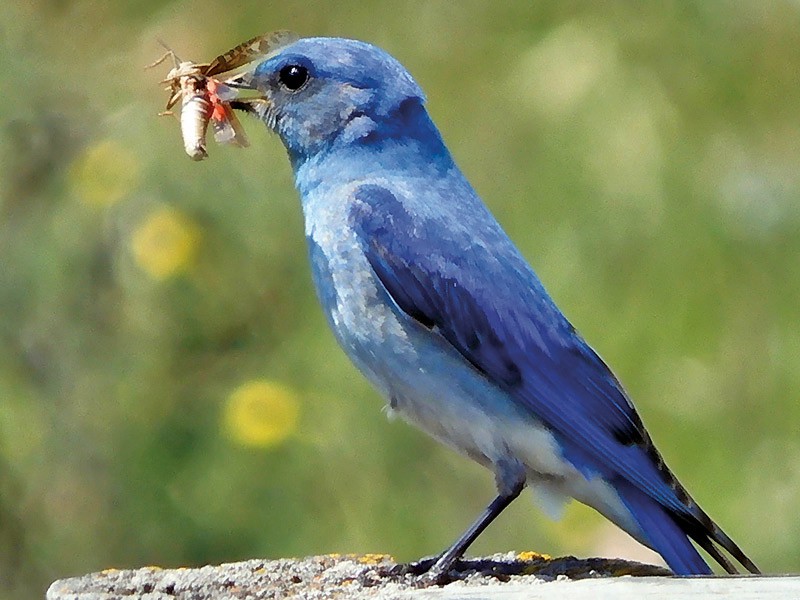
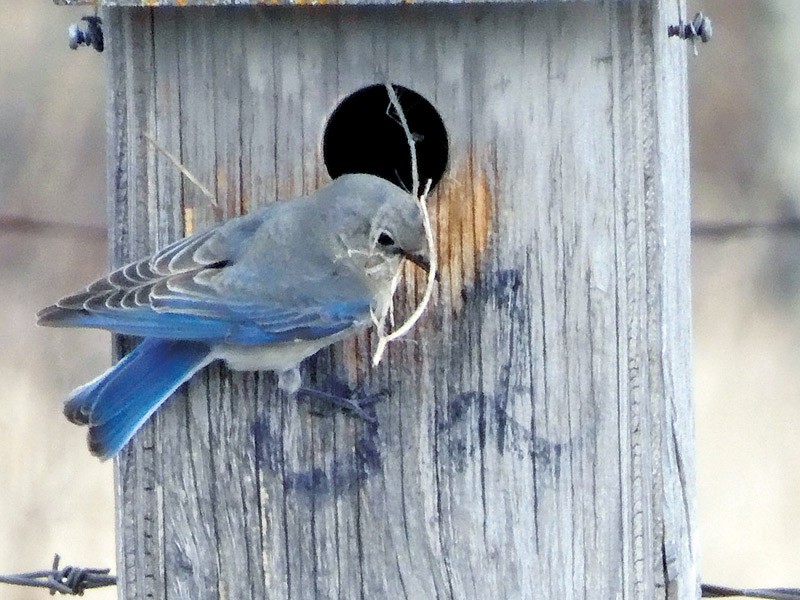
It wasn’t long after I started to photograph our bluebirds that I found myself intrigued by whatever the adults, when leaving the birdhouses, were removing from the nests. Occasionally, they would exit with something white dangling from their beaks. At first I thought it was a piece of the eggshell but I was wrong. After doing a bit of research, I found that it was what is referred to as “fecal sacs”, which are a bright white “diaper” that is produced by the nestlings for the purpose of creating a cleaner nesting area. The never-ending ingenuity of Mother Nature.
I am biased but in my opinion, all bluebirds are stunning but if you’re patient, and when the sun is out, it’s amazing how the colour variations will provide you with a wide array of different looks. As expected, the male has the deeper, vibrant blue whereas the female is predominately a gray/light blue.
In addition to the various shades of blue, I get a kick out of trying to capture the exact moment, with my camera, when mama or papa bluebird are securely holding a grasshopper, fly or grub of some kind that will soon become dinner for one of their ravenous infants. One can only marvel at the endless energy, and dedication, each pair of bluebirds share for their young.
So, let’s do a bit of math. The bluebirds arrive from their migration in the latter part of March to late April. Then comes the courtship process and laying claim to a specific birdhouse. Once this is done, then the renovation project. Every spring there’s always a few touchups to the existing nest, inside the birdhouse, by means of gathering some of the local grass, twigs, etc. Then anywhere from four to six eggs are laid with incubation being 13 to 14 days on average. Then approximately three weeks to leave the nest, so we’re talking only six weeks from the time the first egg is laid until the young bluebirds have literally left the nest, approximately eight to 10 weeks in total from the start of their arrival in Alberta.
By mid to late July, most bird boxes are now empty. You might still find the odd bluebird in early August, but it is so much easier and fun to observe them earlier in the year.
More than 15 years ago I was the Band Manager for the Stoney community of Eden Valley, 20 minutes west of Longview, for a couple of years. Each spring, I would drive to work with the sun to my back, snow topped mountains in front of me and bluebirds everywhere. I truly believed I had the most beautiful and relaxing commute on the planet.
Since then, I’ve tried to make it a habit every spring to get out about a half-dozen times to watch these beautiful birds. For me, it never gets old. I strongly encourage you to find out where the closest collection of bluebird boxes is in your area and when you have an afternoon to yourself, a half a tank of gas and a chocolate bar or two, I can’t think of a better way to relax—one could do a lot worse!
And if you’re west of Longview and see a bright red Dodge Ram parked on the side of the road, please stop and say hello.
For the previous Reader Story, click here.
